Last updated November 18, 2026
Free written scope consultation - allowances, timeline, and change-order rules on paper before a single trade is scheduled
The Complete Driveway & Pavers Guide for Santa Ana Homeowners
A paver surface installed over an improperly compacted base in Santa Ana’s expansive soil conditions can show rocking and settling within 18 months, long before the product warranty on the pavers themselves has even been tested. Most guides to driveway pavers are written for cooler, wetter climates where freeze-thaw cycles do the damage. Santa Ana doesn’t work that way. Here, the clay does the damage, and it does it quietly, from underneath, while the surface still looks fine. This guide treats the compacted base layer as the real product and the pavers as the finish on top. You’ll find base-depth numbers, locally stocked brands, Santa Ana’s right-of-way permit rules, and real Orange County pricing.
Quick Answer
A driveway paver installation in Santa Ana should cost roughly $14 to $26 per square foot for materials and labor combined, and the base matters more than the paver. Plan on 6 to 8 inches of compacted Class II aggregate base to absorb the movement of Santa Ana’s clay-heavy soils, and expect the base and compaction work to run about 35 to 45 percent of your total project cost. Choose a locally stocked paver line, confirm whether your project touches the public right-of-way before you buy anything, and insist on a written, line-item price before work starts.
Styles & brands we work with
- Kitchen remodeling
- Bathroom remodeling
- Home additions & ADU
- Roofing
- Windows & doors
- Driveway & pavers
- Fence
Table of Contents
- Why Santa Ana’s Soil Decides Whether Your Pavers Last
- Base Depth: The Number That Actually Matters
- Which Paver Brands Are Stocked Locally in Santa Ana
- Joint Sand in a Climate With Almost No Freeze-Thaw
- Permits and the Public Right-of-Way in Santa Ana
- What Driveway Pavers Cost in Orange County Right Now
- Pavers vs. Concrete in Santa Ana
- The Installation Sequence, Step by Step
Why Santa Ana’s Soil Decides Whether Your Pavers Last
Santa Ana sits on clay-heavy ground that swells when it takes on water and shrinks as it dries. During a wet winter, that clay can lift and press against a driveway base. Through a long dry summer, it pulls away and settles back. This is the single biggest reason driveway pavers fail in Santa Ana, and it’s the reason a paver job that would be perfectly fine in Phoenix or Portland can go wrong here. The paver doesn’t crack. The base moves, a corner rocks, a joint opens, and water finds its way underneath, and from that point the failure accelerates.
Most of Santa Ana’s residential lots were graded decades ago, and some sit on fill rather than native soil. Fill behaves differently from the clay around it, which is why we ask about grading history and look at how existing driveways on the street are faring. Cracks that run in the same direction across several neighboring driveways are a strong signal of expansive soil and poor drainage in that stretch of street. That’s information you can gather yourself before you ever get a quote.
What this means practically: a base built for a stable, sandy subgrade won’t hold up on Santa Ana clay. The compensating factor is depth and compaction, which is the subject of the next section. Under Clause 1 of our written pricing standard, the base depth and aggregate specification get spelled out in the quote before anyone starts digging, so you can compare depth rather than just pay-per-square-foot.
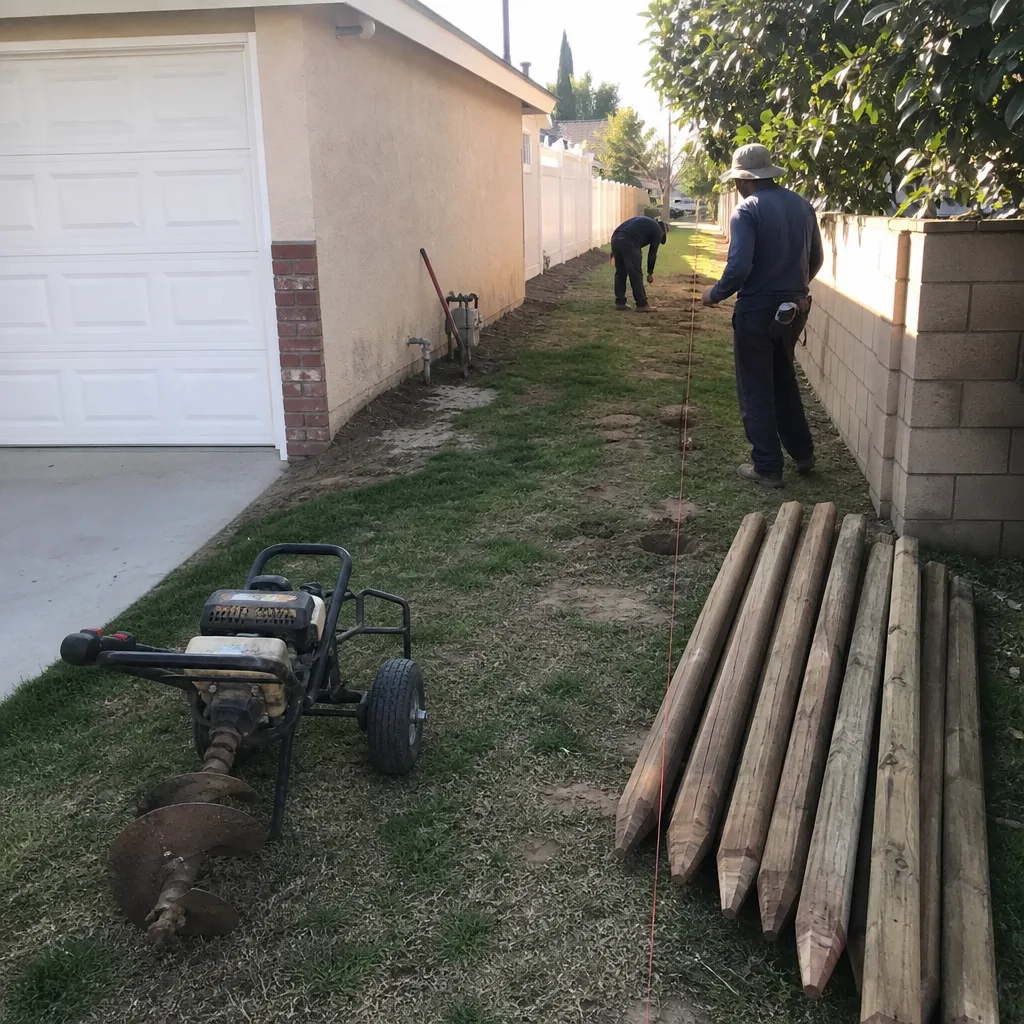
If your project also involves a new entryway or a driveway that runs alongside a new boundary line, the same soil has to be accounted for there too. Our fence installation in Santa Ana work faces the identical problem with post footings, and the solutions overlap more than most homeowners expect.
Base Depth: The Number That Actually Matters
For a residential driveway in Santa Ana, plan on 6 to 8 inches of compacted Class II aggregate base, installed in two or three lifts and compacted between each lift. Class II aggregate base is a graded crushed-rock mix, meaning the particle sizes are controlled so it locks together under compaction instead of staying loose. That locking is what distributes the load of a vehicle across the ground beneath and absorbs the movement of expansive clay.
Here’s the part most homeowners don’t hear: the base is compacted in layers, not dumped and rolled once. A single 8-inch lift won’t compact evenly. Two 4-inch lifts, each compacted to density before the next goes on, will. In our experience, the paver installs that fail in Santa Ana are almost always the ones where the base was poured in one pass or where compaction was eyeballed rather than checked.
The order of operations under the pavers matters as much as the base aggregate:
- Excavation. Dig down to account for base depth, bedding sand, and paver thickness. Skipping this step is how driveways end up higher than every adjacent surface.
- Subgrade prep. Grade for drainage away from the house and any garage, then compact the native soil itself before adding anything.
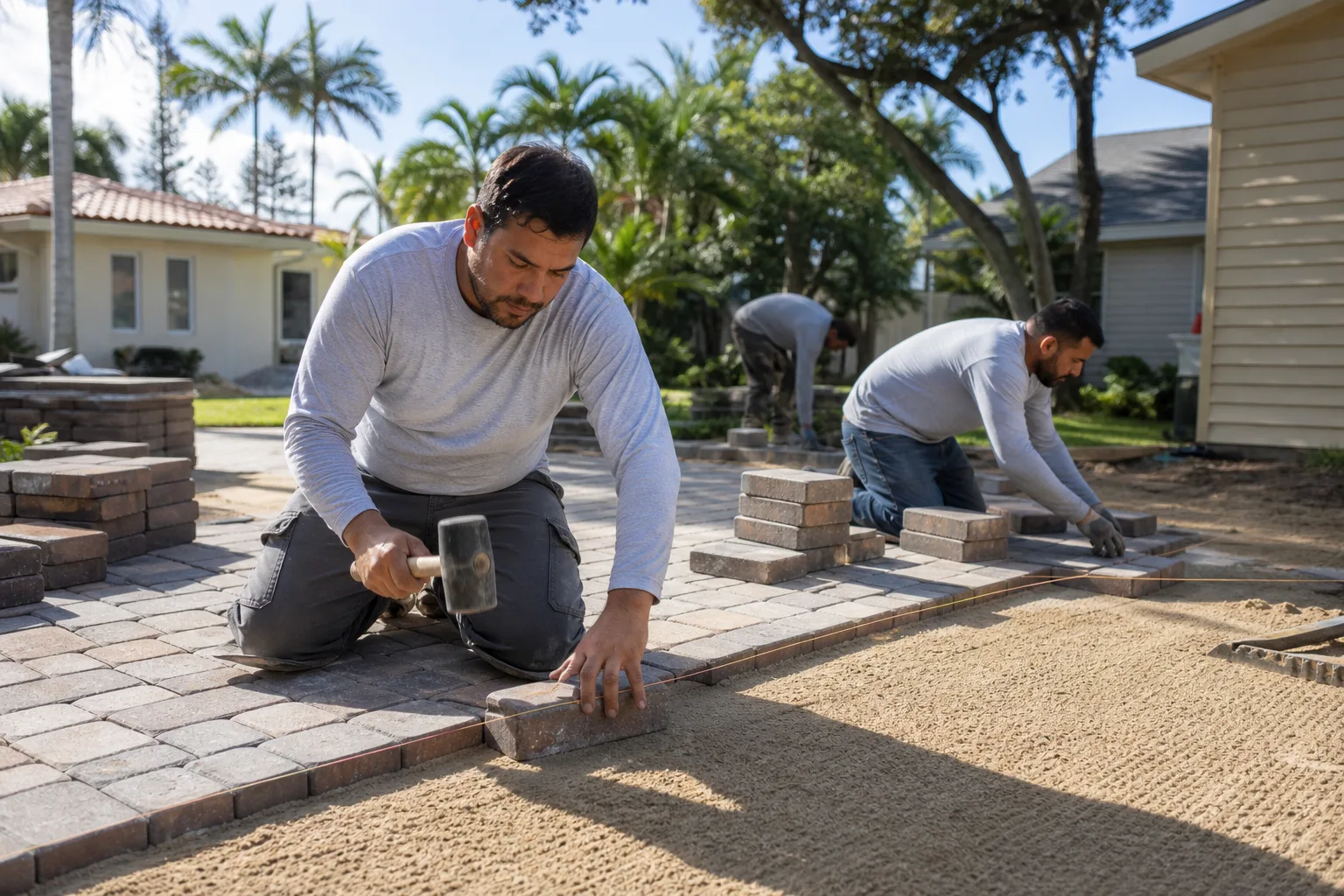
- Aggregate base in lifts. Install Class II base in 3 to 4 inch layers, compacting each to density with a plate or roller.
- Geotextile fabric (where specified). A separation fabric can be used between the subgrade and the base to keep clay fines from migrating up into the aggregate.
- Bedding sand. One inch of coarse bedding sand, screeded flat, not a thick sand pad. Thick sand is a common shortcut that leads to rocking.
- Edge restraint. The base and the pavers need a fixed edge restraint set into concrete. The restraint, and not the friction of the pavers, is what keeps the field from spreading.
Base depth is an area where the lowest bid and the right bid diverge. A contractor who quotes 4 inches of base is not wrong for every site, but on Santa Ana’s clay, 6 to 8 inches is the working number. Ask for the base depth in writing. If it isn’t written down, it isn’t specified.
Which Paver Brands Are Stocked Locally in Santa Ana
Paver lead times in Orange County vary widely by brand and line. Big local box-retail lines like Pavestone and the regional Angelus lines that show up at stone yards around Santa Ana are typically stocked, which means you can order replacements years later without a wait. Belgard is a strong, widely specified option with a deep style catalog, but individual Belgard lines and colors can be special-order, so a specific color may carry a lead time. Techo-Bloc is on the higher end of the market with a corresponding lead time for non-stocked colors.
The practical consequences of stocked versus special-order:
- Stocked lines (Pavestone, Angelus, and common Belgard colors): generally available fast, and small quantities for repairs are easy to match later.
- Special-order lines: a longer lead time, and a true color or size match for future repairs may not be possible once a run sells out. Buy 5 to 10 percent extra at installation and store it.
We source across 50-plus vetted material brands, which is how we can put honest short-money numbers in a quote instead of inflated ones. When a homeowner asks about Belgard or Angelus, we tell them which colors are locally stocked in Santa Ana and which may add weeks. The right call is often a stocked color with a good style over a perfect color that turns your driveway into a 3-month project. For materials, brands, and lead-time tolerances, a written scope should name the exact SKU, not just “gray pavers.”
Joint Sand in a Climate With Almost No Freeze-Thaw
Santa Ana has minimal freeze-thaw activity compared with northern climates, so a lot of the northern guide advice about joint sand doesn’t apply here. The function of joint sand in Santa Ana is stabilization and weed suppression, not resisting frost heave. That changes the product selection.
Most residential paver installations in Santa Ana do well with a coarse, well-graded joint sand that fills the joints and locks the pavers. Polymeric sand, which hardens slightly after wetting, can be a fit but behaves differently here: it needs to be installed at the right moisture and cured fully, and in Santa Ana’s heat the install window matters. We generally recommend polymeric in areas where you want to reduce weed intrusion and resist water washing joints out, and plain coarse sand where the driveway is sheltered and the owner prefers a sand joint that can be topped off. The critical point: the sand has to actually fill each joint, not skim the surface. Sand installed over a damp joint will bridge and wash away over one rain event.
The Santa Ana-specific issues with joint sand are heat and rain intensity, not freezing. That’s why the joint sand gets installed dry, swept in with a plate vibrator over the pavers, and watered in deliberately. Skip any of that step and you’ll see the joints open again after the first wet season, regardless of how good the paver is.
Permits and the Public Right-of-Way in Santa Ana
Any driveway work that changes the connection to the street, alters a curb, cut, or sidewalk apron, or affects stormwater flow across the sidewalk almost certainly touches the public right-of-way, and in Santa Ana that work requires a permit and typically a right-of-way encroachment approval before work starts. Standard things to confirm with the city before you buy material:
- Whether your project changes the driveway apron or curb line at the street, which crosses into public right-of-way.
- Whether your original driveway permit or grading record still limits the driveway width and location.
- Whether the sidewalk and apron will be removed and replaced, and who is responsible for that portion.
- Whether stormwater must sheet away from the street and toward the property, and how that gets verified.
Inside your own property line, most paver resurfacing work that doesn’t change grade, drainage, or a structure may not require a permit, but the specifics vary with lot, location, and how much grading is involved. The safe answer is to ask the city before you assume, and to write the permit responsibility into the scope with your contractor. Permits pulled and inspections passed is a line we like to see in a quote, because it tells you who is carrying the approval and who stands behind it. A contractor who offers to skip permitting because “nobody checks” is telling you how the rest of the job will go.
Homeowners sometimes fold a driveway project into a broader outdoor build. If you’re thinking about a garage conversion or a detached structure, the driveway, drainage, and access all interact with that build. Our Home Additions & ADU in Santa Ana team plans those site elements as one system.
What Driveway Pavers Cost in Orange County Right Now
Driveway pavers in Santa Ana run roughly $14 to $26 per square foot for materials plus labor at current Orange County pricing, not national averages. A typical two-car driveway of about 400 square feet lands somewhere in the $5,600 to $10,400 range before any extra removal, demolition, or right-of-way work. Material choice and base condition move the number more than anything else.
Break the cost down the way a written quote should:
| Line item | Typical Santa Ana range |
|---|---|
| Paver material (interlocking concrete) | $3 – $7 per sq ft |
| Class II aggregate base, 6 – 8 in compacted | $2 – $4 per sq ft |
| Labor (excavation, base, install, compaction) | $6 – $12 per sq ft |
| Bedding sand, joint sand, edge restraint | $1.50 – $3 per sq ft |
| Removal and hauling of old concrete or asphalt | $1.50 – $4 per sq ft |
| Right-of-way permit and apron work (if applicable) | quoted separately |
Two numbers matter more than the headline cost. First, the base and compaction portion is 35 to 45 percent of a well-built job, and a quote that prices the pavers and skimps on base is understating the real total. Second, the lowest per-square-foot number you see often reflects thinner base and no edge restraint, which is where failures start. In our experience, a written flat price with line items lets a homeowner compare apples to apples across quotes, which is also why we offer a free second opinion on any written estimate.
Other Santa Ana outdoor flatwork
If you’re comparing driveway pavers to other hardscape around the property, the same base logic and the same written-price logic apply to patios, walkways, pool decks, and driveways. The best starting point is our overview of Driveway & Pavers in Santa Ana, and the Rowan Construction Group Santa Ana home page if you’re weighing multiple projects at once.
Pavers vs. Concrete in Santa Ana
Concrete is cheaper up front and pavers are more forgiving over time. In Santa Ana’s expansive clay, a poured concrete driveway has one significant weakness: when the clay moves, the slab has nowhere to go, so it cracks. Pavers move with the ground, and a settled paver field can be lifted and re-set rather than cut out and replaced. That repair capability is the real reason to choose pavers here. Most concrete failures are a base failure that you can see; a paver failure is a base failure you can fix without tearing out the entire driveway.
- Concrete: typically $8 to $14 per sq ft, faster install, but cracking risk in Santa Ana clay is real and repairs are whole-slab.
- Pavers: typically $14 to $26 per sq ft, longer install, but individual pavers can be lifted and reset and a settled area is a repair, not a replacement.
The verdict depends on the site. On stable ground, concrete is a fine, cost-effective choice. On a lot where neighboring driveways are cracking, or where the connection to the street will see lifted weight, pavers give you a serviceable system rather than a permanent slab. Ask any contractor which ground condition they’ve diagnosed, and expect a specific answer. That is the difference between a bid and a recommendation.
The Installation Sequence, Step by Step
Here’s the sequence we use and what a homeowner should expect at each stage:
- Site assessment and written quote. Grade, drainage, existing pavement condition, soil indicators, and the permit picture get reviewed. You receive a flat written price with scope, base depth, and warranty before any work starts.
- Permit and scheduling (if right-of-way work applies). The permit is pulled and any city inspection is scheduled before demolition.
- Demolition and haul-off. Existing concrete or asphalt is removed and hauled away. Base is excavated to final grade.
- Subgrade and base install. Native soil is compacted, then Class II aggregate base in controlled lifts, each compacted.
- Bedding sand, pavers, edge restraint. A screeded sand bed, then pavers laid to pattern, then the edge restraint set into concrete.
- Compaction and joint sand. The field is plate-compacted, then joint sand is swept in, compacted, and watered in.
- Cleanup and photo record. Site cleanup, a final walkthrough with you, and a documented photo record of the finished work.
Every visit from our background-checked, uniformed technicians includes a documented photo record as standard, not an upgrade. On a driveway project that means photos of base depth and compaction before the pavers go down, which is the evidence you actually want. Under the 365-Day Done Right Promise, if something isn’t right it gets made right, and the promise is backed by a terms page rather than a handshake.
Common Mistakes to Avoid
- Quoting on pavers and skipping the base. The per-square-foot price is where a thin base hides. Ask for the base depth in writing.
- Installing in one thick lift. A base compacted in a single 8-inch pass will not reach density. It should go in layers.
- Choosing a special-order color and buying no spares. In Santa Ana, a hot special-order line can sell out of a color, and a future repair match may be impossible. Buy extras at install.
- Assuming the driveway can be widened without checking the right-of-way. The apron, curb, and sidewalk all sit in the public right-of-way and involve a permit.
- Letting water run toward the garage. Grade and drainage should move water away from the structure, and the finished heights have to be planned, not improvised.
- Using the wrong joint sand or skimping on the joint fill. Santa Ana’s heat and heavy rain events will open skimpily filled joints fast.
- Hiring on the headline price alone. A written flat price with line items and a written warranty is the only bid that can be compared honestly to another.
See the difference
 Before
 After
 Before
 After
 Before
 After
When to Call a Professional
Call a professional if your existing driveway is rocking, if joints are opening and re-opening after filling, if water pools near the garage or front walk, or if you’re considering a driveway widening or apron change that runs to the street. Those are the situations where base and drainage design decide the outcome, and where a Santa Ana permit may be part of the work. Seriously uneven base conditions and right-of-way changes aren’t a weekend DIY project, and a mistake there is expensive to undo. Rowan Construction Group Santa Ana offers free estimates in Santa Ana, with a written flat price and scope before any work starts. Call (833) 853-5955 to schedule yours, and if you have a competitor’s written quote, we’ll review it line by line at no charge.
Frequently Asked Questions
Plan on about $14 to $26 per square foot for materials and labor combined, so a 400-square-foot driveway typically runs $5,600 to $10,400 before removal or right-of-way work. The base and compaction are 35 to 45 percent of that total, and skipping depth to lower the price is the most common cut. Call (833) 853-5955 for an exact quote, with estimates are free.
Use 6 to 8 inches of compacted Class II aggregate base, installed in 3 to 4 inch lifts and compacted between each lift. Santa Ana’s clay-heavy soil is expansive, meaning it swells and shrinks with moisture, and that base depth is what absorbs the movement. A 4-inch base is common in dry, stable climates but is too shallow for most Santa Ana lots.
If the work changes the driveway apron, curb, sidewalk, or how water flows across the public right-of-way, you almost certainly need a permit and right-of-way approval. Work fully inside your property that doesn’t change grade or drainage may not need one, but confirm with the city before you buy material. Ask your contractor to put permit responsibility in the written scope.
Pavestone, Angelus, and common Belgard colors are typically stocked locally and easy to match later for repairs. Some Belgard lines and many Techo-Bloc colors are special-order and may carry a lead time. Buy 5 to 10 percent extra material at install so replacements match years from now.
Rocking usually means the base moved, not that the pavers are defective. In Santa Ana, expansive clay and a thin or under-compacted base are the usual causes, and it can show up within 18 months. The fix depends on the cause: an edge or joint issue is small, while a base failure means lifting and re-doing the base under the affected area.
Pavers hold up better over Santa Ana’s moving clay because a settled area can be lifted and reset, while a cracked concrete slab has to be cut out and replaced. Concrete is cheaper up front at $8 to $14 per square foot. If neighboring driveways are cracking, the paver system is the more serviceable choice. Call (833) 853-5955 and we’ll walk you through the right call for your lot at no charge.
The Bottom Line
In Santa Ana, the pavers are the finish and the base is the product. Get 6 to 8 inches of compacted Class II aggregate in proper lifts, choose a locally stocked paver line so repairs remain possible, select joint sand for heat and rain rather than freeze-thaw, and settle the permit question before the first shovel. Price the job on line items at current Orange County rates, not national averages, and insist on a written flat price with a written warranty before work starts. Do those things and a paver driveway should serve for a long time. Skip them and the clay will find out.
Rowan Construction Group Santa Ana works from a written price before any work starts, on every trade, backed by the 365-Day Done Right Promise. Call (833) 853-5955 for a free estimate and a flat written price on your driveway and pavers project.
Written by the team at Rowan Construction Group Santa Ana.