Last updated November 18, 2026


Free written scope consultation - allowances, timeline, and change-order rules on paper before a single trade is scheduled
How Long Does Driveway & Pavers Take? Timelines and What to Expect
Here is the number most Santa Ana homeowners don’t see until the job is underway: a 400-square-foot paver driveway replacement runs 7 to 12 calendar days from first excavation to final sealing, but the driveway is unusable for a continuous 4 to 6 day stretch in the middle of that window. The pavers themselves go down in a day. Everything else – the demolition, the graded base, the compaction lifts, the curing – is what sets the schedule and keeps your cars on the street. This guide breaks the project into phases with real day counts, explains why the base work can’t be rushed, and shows you what a written schedule should look like before you sign anything in Santa Ana.
Quick Answer
A driveway paver installation in Santa Ana typically takes 7 to 12 calendar days for a standard 400-square-foot driveway, with larger or complex jobs stretching to 2 to 3 weeks. Paver laying itself is one day for that size; excavation, base compaction in lifts, joint sanding, and sealer curing account for most of the rest. Plan on losing vehicle access for 4 to 6 continuous days in the middle of the project, not just on the days a crew is on site.
Styles & brands we work with
- Kitchen remodeling
- Bathroom remodeling
- Home additions & ADU
- Roofing
- Windows & doors
- Driveway & pavers
- Fence
Table of Contents
- Phase by Phase: Where the Days Actually Go
- Permits and Scheduling: The Invisible Week
- Why Compaction Happens in Lifts, Not One Deep Pour
- Material Lead Times and What’s Actually In Stock
- Weather Windows and Sealer Temperatures in Santa Ana
- What a Written Project Schedule Should Contain
- How Payment Releases Should Tie to Milestones
- Living Without Driveway Access: A Realistic Plan
Phase by Phase: Where the Days Actually Go
Most timeline quotes compress the project into a single number and leave you to guess where the time went. Here is the honest breakdown for a standard residential driveway in Santa Ana. The paver-laying phase, the one homeowners picture when they imagine the job, is the shortest block on the list.
- Permit and inspection scheduling: 3 to 10 business days, depending on scope, right-of-way involvement, and current city queue.
- Excavation and haul-off: roughly 1 day per 500 square feet. A 400-square-foot driveway is a day; a 1,200-square-foot driveway is 2 to 3 days with dumpster logistics.
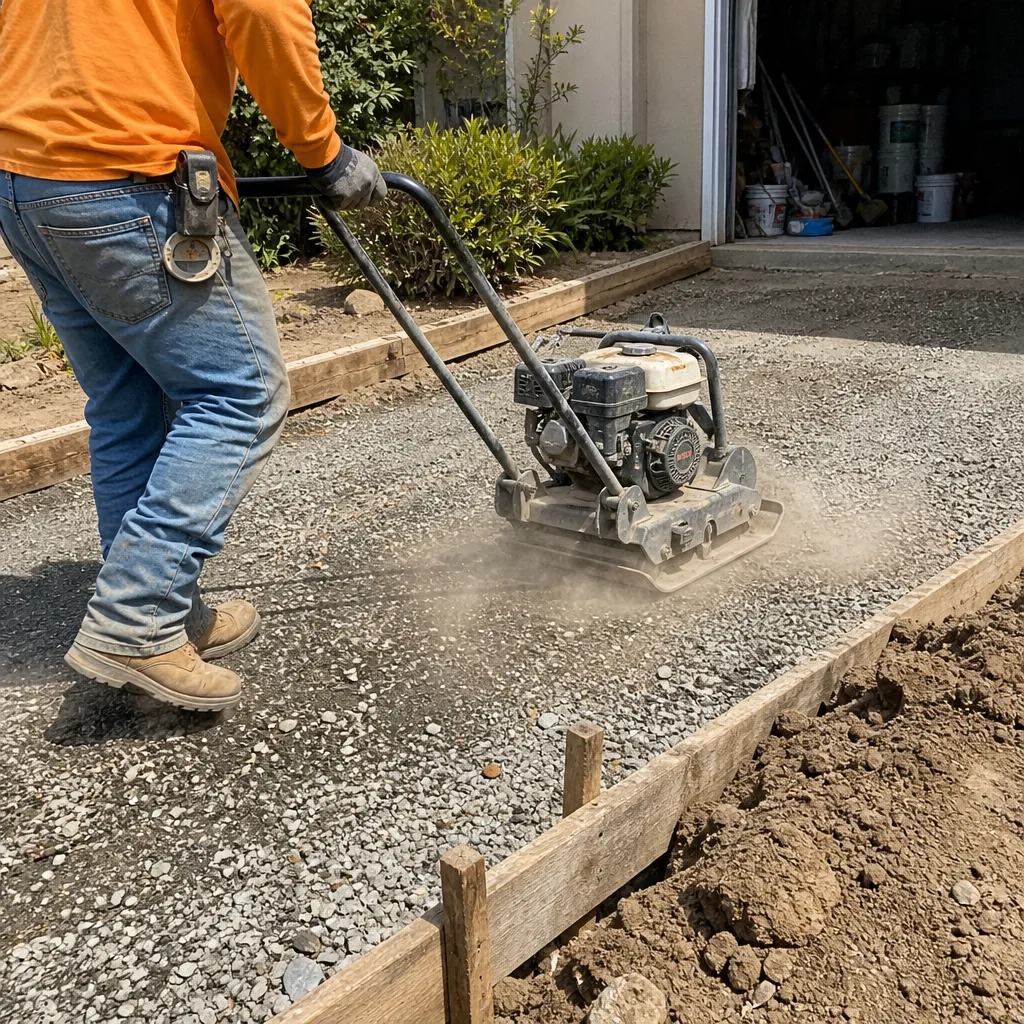
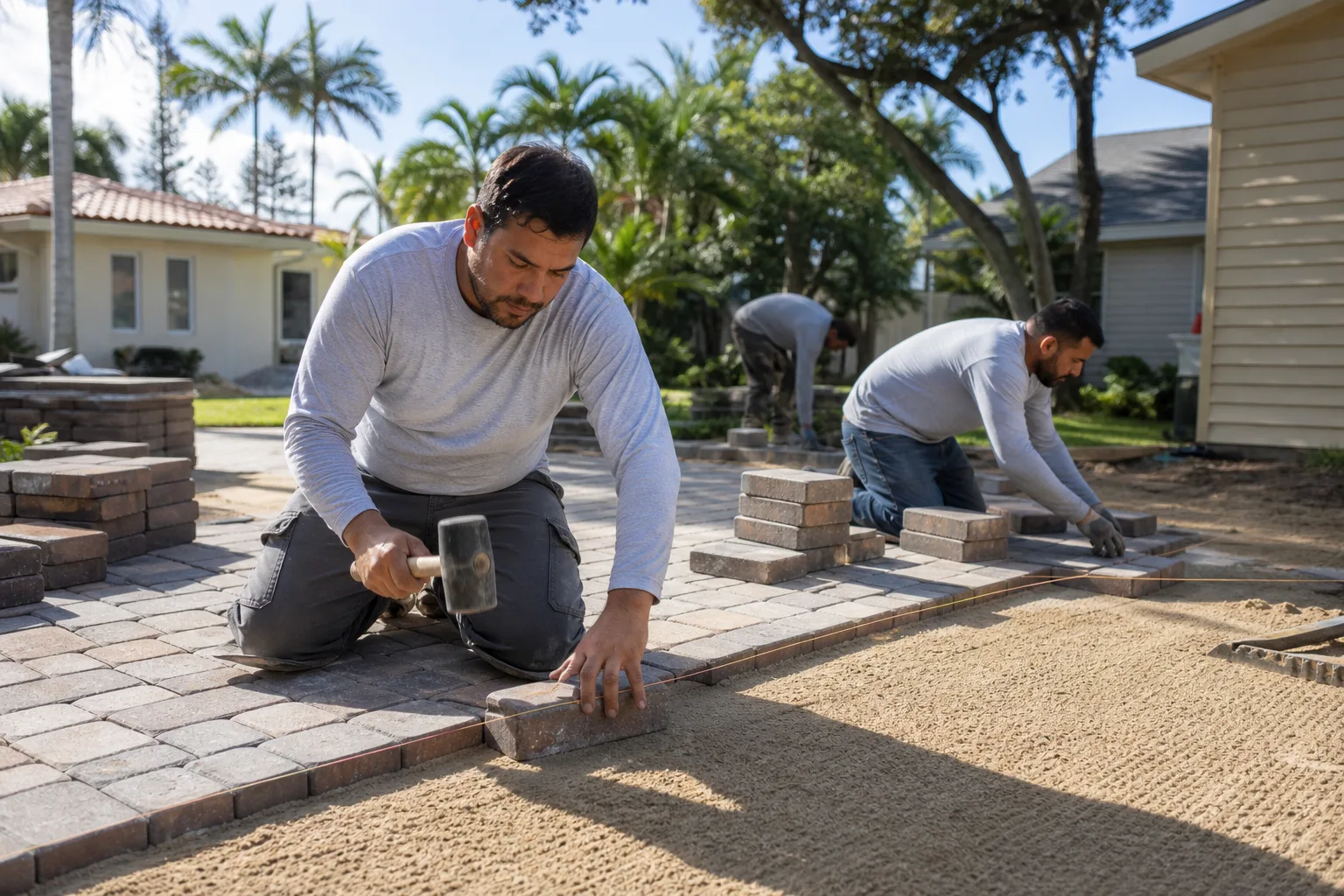
- Base installation and compaction: 1 to 2 days. Class II base material placed in 3 to 4 inch lifts, each compacted before the next is added.
- Paver laying: 1 day per 300 to 400 square feet for a crew of three. A 400-square-foot driveway is a single day.
- Edge restraints and joint sand: half a day to a full day, depending on border pattern and cuts.
- Sealing and curing: 1 day to apply, plus 24 to 48 hours before vehicle traffic and longer before heavy loads.
Add those up and a 400-square-foot Santa Ana driveway lands at 7 to 12 calendar days once you account for crew gaps and material delivery. A larger job in a neighborhood like Floral Park, where driveways are longer and the mature trees complicate access, can stretch to 2 or 3 weeks.
Permits and Scheduling: The Invisible Week
Permit review is the phase that quietly breaks the timeline estimate you were given over the phone. In Santa Ana, a driveway replacement that stays entirely on private property often moves through the process faster than one that touches the sidewalk, curb, or right-of-way. Anything involving curb cuts, drainage tie-ins, or a change to the apron triggers additional review and sometimes a separate inspection.
Here is what to ask before the crew schedules anything:
- Does this scope require a permit, and who pulls it? A written quote should name this in the scope, not leave it to chance.
- What is the current review turnaround for this permit type at the Santa Ana office?
- Are there inspections required at excavation, at base, and at final? Each one adds a scheduling day.
- Which party absorbs a delay if the inspection doesn’t clear on the first pass?
The reason permit timing matters so much is that crews can’t do anything useful during the wait. Excavation can’t start until the permit posts. If your quote shows a 7-day project but the permit takes 8 business days, the real calendar commitment is closer to 3 weeks. That gap is where most homeowner frustration lives. When we quote Driveway & Pavers in Santa Ana, we put the permit step on the written schedule with its own line so the customer can see exactly where the wait sits.
Why Compaction Happens in Lifts, Not One Deep Pour
This is the phase that determines whether your driveway still looks level in 18 months or whether you’re calling someone to fix sunken pavers, cracked borders, and pooling water at the garage threshold. A paver driveway fails from the base down, not the surface up. When someone skips compaction steps to save a day, the settlement shows up later, usually after the first wet winter or a few months of a loaded SUV parking in the same spot.
Base material – the Class II aggregate under the pavers – has to be placed in 3 to 4 inch lifts. That means a layer goes down, gets compacted with a plate or roller, gets measured for moisture and density, and only then does the next lift go on. A 6 inch base for a residential driveway is typically placed in two lifts; a heavier-duty base for a driveway used by a work truck or an RV might be 8 to 10 inches in three lifts.
What one deep pour looks like instead: the aggregate goes in at 8 inches at once, the compactor only reaches the top 3 or 4 inches, and the lower half stays loose. The pavers look perfect on install day. Eighteen months later the middle of the driveway has a shallow bowl that holds water, the top course of pavers is out of plane, and the fix means pulling up the pavers and redoing the base. Saving one day at installation becomes a multi-day removal job later.
A written scope should state the base depth and the lift schedule explicitly. “Compacted base” without a number is not a specification.
Material Lead Times and What’s Actually In Stock
The paver selection you make at the showroom affects your timeline before a single shovel hits the ground. Standard in-stock lines from Belgard and Techo-Bloc typically move from a Santa Ana-area supplier in days. Special-order colors, custom blends, and large-format pavers can add 2 to 4 weeks to the front of the schedule while the material is being manufactured and shipped.
A practical way to think about it:
- In-stock Belgard and Techo-Bloc lines: typically available in days for standard colors and patterns.
- Special-order colors or discontinued-blend matching: often 2 to 4 weeks.
- Large-format or custom-cut pavers: lead time plus a cutting allowance on site.
- Permeable paver systems with specific open-graded base specs: check availability before committing, the base aggregate has its own lead time.
Factory-built modules from Mighty Buildings and Boxabl have their own, much longer, delivery schedules and are not used in paver driveway work – the point is simply that material lead time is real and should be confirmed in writing before a start date is locked. The best time to check is before the permit is filed, so both clocks run in parallel.
Weather Windows and Sealer Temperatures in Santa Ana
Santa Ana’s climate is forgiving. It is not, however, year-round compatible with paver sealing. Sealer manufacturers publish a window: generally surface temperatures above 50°F and below 90°F at application, with no rain in the forecast for 24 to 48 hours afterward. A Santa Ana heat event that pushes pavement surface temperature past 90°F means the sealer flashes too fast, cures unevenly, and can leave a milky film or a blotchy finish that has to be stripped and reapplied.
Practically, that means a mid-summer installation may push the sealing phase to an early morning window or postpone it a day or two. A cloudy week in late fall might mean waiting for a dry stretch between rain. Both are correct calls, and neither is a sign the crew is slow. A contractor who seals anyway on a day outside the temperature range is betting your finish on a technicality.
Winter rains in Santa Ana and the surrounding county also matter for the base. Wet aggregate can’t be compacted to spec. A day or two after meaningful rain is lost to drying, not to laziness. Good scheduling builds a weather buffer into the calendar, especially for projects between November and March.
What a Written Project Schedule Should Contain
A verbal timeline is a wish. A written schedule is a commitment. Any quote for a driveway or paver project should include a schedule document – not a sentence in the estimate, an actual schedule – and it should list the following:
- Start date tied to permit issuance, not a hard date promised before the permit is filed.
- Each phase with its expected duration in days, including the excavation, base, laying, and sealing phases separately.
- Material delivery date and the specific paver line, color, and quantity in the written scope.
- Inspection dates with the city, if applicable, and who is responsible for attending.
- Weather-contingency language that says how many days of buffer are built in.
- Milestone markers with written acceptance criteria so the customer knows when a phase is genuinely complete.
Under Clause 1 of the Haven Standard, the price is written before anyone starts, and the same discipline applies to the schedule. No work proceeds on a change until the change order is signed – if a buried utility line shows up during excavation and the scope needs to shift, the schedule is revised in writing, not adjusted conversationally.
How Payment Releases Should Tie to Milestones
The schedule and payment schedule should be the same document. Payments tied to dates instead of milestones let the money outrun the work. Payments tied to milestones keep both sides honest and force the schedule to stay visible.
- Deposit on signing, sized to cover material order and permit fees.
- Second release on completion of excavation and approved base compaction – after inspection passes if one is required.
- Third release on completion of paver laying and edge restraint install.
- Final payment after joint sand, sealing, and a documented walkthrough that includes the written warranty.
If a payment milestone and a work milestone cannot both be checked off on the same day, the contract should say which one governs. Ours says the work. That is the point of a written schedule – it gives both sides a shared reference point when the calendar and the crew’s progress disagree.
Living Without Driveway Access: A Realistic Plan
The stretch homeowners most often underestimate is the middle of the job, when the base is exposed and the pavers haven’t gone down yet. From the day excavation begins to the day sealer has cured, the driveway is not available for vehicles. That is typically 4 to 6 continuous days for a 400-square-foot job, and it overlaps with the days no crew may be on site – like the wait between base compaction and inspection clearance.
A usable plan for that window:
- Move both cars to the street the night before excavation. Confirm any HOA or city rules about overnight street parking first.
- Check whether trash pickup will need to happen from the curb that week.
- Plan deliveries and rideshare pickups to the street, not the driveway.
- If you have an RV or boat trailer, arrange off-site storage for the full window – the 4-to-6-day assumption doesn’t include a vehicle that needs a wider turning radius.
For homes in neighborhoods like Wilshire Square or Washington Square where driveways are short and street parking is tight, that two-car street plan needs to be sorted before the schedule is locked. The customer who gets caught out is usually the one whose second car was assumed to fit somewhere.
Common Mistakes to Avoid
- Choosing the lowest bid with the fastest quoted timeline. The days saved almost always come out of base compaction, and that’s the part you can’t see.
- Ordering special pavers late. A custom Belgard or Techo-Bloc blend can eat 2 to 4 weeks, pushing the whole schedule. Confirm the material line in the written scope before the permit goes in.
- Assuming the “7-day project” quote is 7 calendar days on your driveway. It almost never is. Ask for the schedule as a document.
- Sealing on a hot Santa Ana afternoon. If the surface is over 90°F, the sealer finish will suffer. A small weather delay is a feature, not a bug.
- Paying on dates instead of milestones. If your payment schedule shows calendar dates rather than completed phases, ask for it to be reworked.
- Underestimating the car-free stretch. The 4-to-6-day access window is longer than the active workdays. Plan parking accordingly, especially in tighter Santa Ana neighborhoods.
- Skipping the base depth number in the written scope. “Compacted base” without a depth is not a spec. Insist on a number in inches and a lift count.
See the difference
 Before
 After
 Before
 After
 Before
 After
When to Call a Professional
If your driveway is showing signs of settlement – pavers that are out of plane, ponding after a rain, borders that have separated, or cracks at the garage threshold – the failure is almost certainly in the base, not the surface. That’s a rebuild, not a patch. If the driveway ties into a right-of-way, involves a curb cut, or has a drainage tie-in, the permit and inspection work alone is worth a professional hand. If you are working with special-order material or a permeable paver system, the base specification has to be right the first time or the whole assembly fails.
Rowan Construction Group Santa Ana offers free estimates in Santa Ana – call (833) 853-5955. We’ll review an existing quote line by line, at no charge, as a free second opinion if you already have one in hand. Our technicians have up to 19 years of experience, and every estimate arrives as a written price before any work starts.
Frequently Asked Questions
A standard 400-square-foot paver driveway in Santa Ana typically takes 7 to 12 calendar days from first excavation to final sealing. Larger driveways, right-of-way work, and special-order materials extend that to 2 to 3 weeks. Call (833) 853-5955 for an exact timeline for your job – estimates are free.
Plan on losing driveway access for a continuous 4 to 6 days in the middle of the project, from excavation through sealer cure. The stretch is longer than the days crews are actively on site because base compaction, inspection clearance, and cure time all keep vehicles off. Move cars to the street the night before excavation begins.
Often yes – especially if the work touches the sidewalk, curb, apron, or a drainage tie-in. A straight replacement that stays entirely on private property may not require a permit, but the scope of the work decides it, not the homeowner’s preference. Confirm this in the written estimate, not verbally. Call (833) 853-5955 and we’ll tell you which category your job falls into.
Because a plate compactor or roller only reaches the top 3 to 4 inches of loose aggregate. A base poured in one deep layer leaves the bottom half loose, and pavers will settle into that looseness within 18 months. Compacting in 3-to-4-inch lifts is the only way to guarantee uniform density. It’s the single most important specification in any paver quote.
Yes, but the sealer application has to respect manufacturer temperature limits: generally under 90°F surface temperature and above 50°F. During an August heat event in Santa Ana, sealing may shift to an early-morning window or wait a day. Any contractor who seals outside the temperature range is betting your finish on a technicality – ask how they schedule hot-weather seals.
Not without a signed change order. If excavation uncovers something the estimate didn’t anticipate – a buried utility, a failed subgrade – a written change order is drafted with the new scope and price, and no work on that change proceeds until the customer signs. That is the discipline that keeps projects within a few percent of the agreed price. Call (833) 853-5955 for a written estimate to compare against any other quote.
The Bottom Line
The paver-laying day is not the project. Excavation, base compaction in lifts, permit timing, material lead times, and sealer cure set the schedule, and they add up to 7 to 12 calendar days on a standard Santa Ana driveway. Plan your vehicle access around the middle 4 to 6 days, ask for the schedule in writing, and tie payment releases to milestones rather than dates. Get the base spec in inches and lifts in the written scope – that number is what determines whether the driveway is still level two winters from now. Compare quotes against the same written schedule, not just the same price.
If you’d rather start from a written number than a phone estimate, that’s exactly what we do first. Rowan Construction Group Santa Ana puts the price and the schedule in writing before anyone picks up a tool – under the 365-Day Done Right Promise and the Haven Standard, backed by a documented photo record on every visit. Call (833) 853-5955 for a free estimate, or bring a competitor’s quote in for a free line-by-line second opinion.
Written by the team at Rowan Construction Group Santa Ana.